Atrium Society Closing After 40+ Years of Peace Education
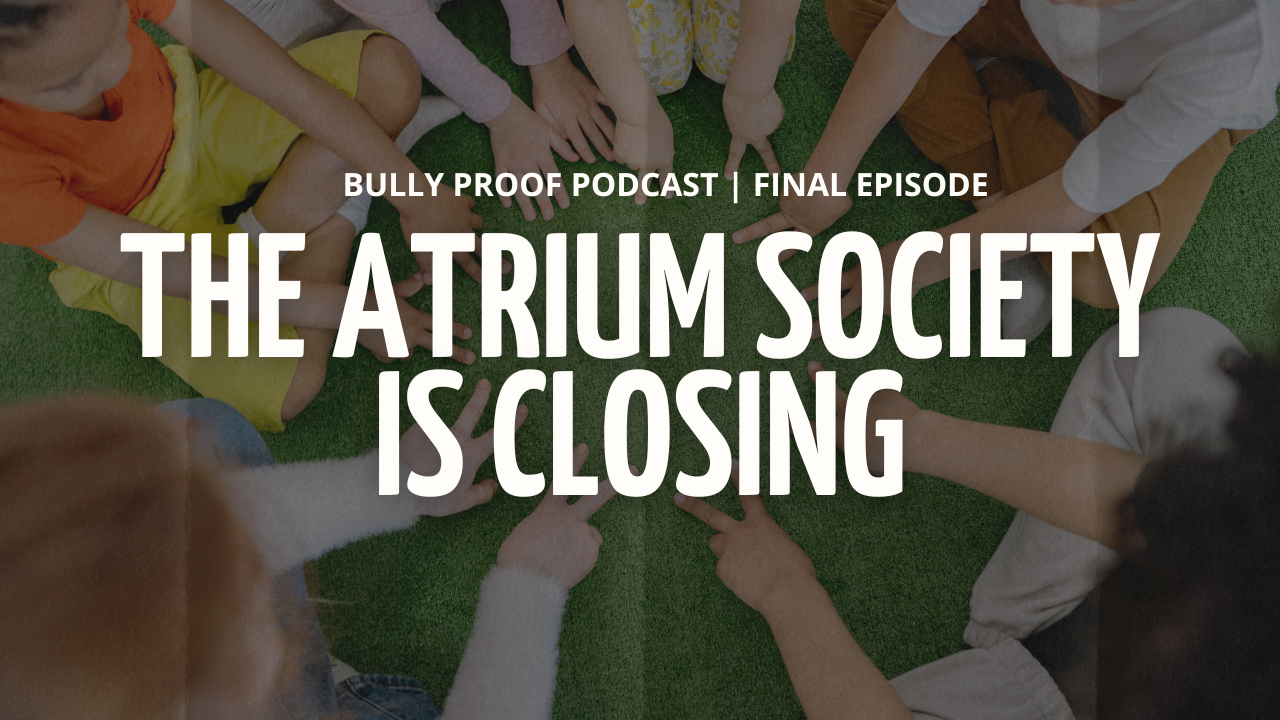
After more than 40 years of peace education, bullying prevention, and conflict education, Atrium Society is officially coming to a close on December 31, 2026. With the organization closing, this also marks the final episode of Bully Proof Your Child.
Rather than focusing on one specific aspect of bullying, as we have in previous episodes, we wanted to use this final conversation to look back at the Atrium Society itself: why the organization began, the work that has taken place over the past four decades, and how the conversations we’ve had on this podcast fit into that much larger story.
This was not a quick or easy decision. Jean Webster-Doyle, who founded the Atrium Society and continues to serve as its president, spent well over a year carefully considering what the future should look like.
The Atrium Society has been a meaningful part of her life for more than four decades, as well as a major part of the life and work she shared with her late husband, Dr. Terrence Webster-Doyle, who passed away in 2023.
For those who have followed Atrium Society for many years and found its work helpful, this may be difficult news. There are more than 40 years of history behind the organization, including books, educational programs, workshops, international projects, and relationships with people around the world.
Before we say goodbye, we want to look back at where it all started.
Why Did Atrium Society Begin?
Jean Webster-Doyle founded Atrium Society in Ojai, California, in 1984, and Dr. Terrence Webster-Doyle became the organization’s director that same year.
From its earliest days, Atrium Society focused on a question that would shape everything that followed:
Why are human beings so often in conflict with one another?
Dr. Webster-Doyle became particularly interested in the role psychological conditioning plays in conflict.
From a young age, we learn who we are, what we believe, where we belong, how we’re supposed to behave, and how we should understand the people around us. Much of this happens without us consciously realizing it. We absorb ideas from our families, schools, communities, cultures, and the world around us.
Eventually, some of those ideas become so familiar that they no longer feel like something we’ve learned. They simply feel true.
Atrium Society’s work asks what happens when that conditioning creates fear, prejudice, division, and ultimately conflict.
For Jean and Dr. Webster-Doyle, education offered an opportunity to make those patterns visible, particularly for young people who are still developing their understanding of themselves and others.
This went further than simply telling children which behaviours are right or wrong. It meant asking questions such as:
- Why do we become afraid of someone?
- Why do we sometimes feel the need to dominate or exclude another person?
- Why do we divide ourselves into groups?
- Why do we react so automatically when we feel threatened?
Those questions became central to Atrium Society’s work in peace education, bullying prevention, and emotional development.
Understanding the Bully-Victim Cycle
Bullying became an especially important part of Atrium Society’s work.
Dr. Webster-Doyle experienced severe bullying himself as a child, so he understood the fear and lasting emotional impact from personal experience.
He was also interested in what happens on all sides of a conflict. This led to one of the concepts we’ve returned to throughout Bully Proof Your Child: the bully-victim cycle.
We often talk about the bully and the victim as though they’re two completely separate kinds of people. In reality, those roles can be much more complicated.
Someone who feels powerless, humiliated, frightened, or excluded may try to regain control by becoming aggressive toward someone else. A person who bullies in one situation may be the victim in another.
Hurt can lead to retaliation; retaliation creates more hurt, and the cycle continues.
For the Atrium Society, this was never only a childhood problem. It was a global one.
The scale of conflict can change dramatically, but many of the underlying psychological patterns remain recognizable.
When fear turns into hostility, when people are divided into “us” and “them,” when one group tries to dominate another, and when retaliation is met with more retaliation, those patterns can appear in prejudice, discrimination, social conflict, and ultimately war.
That doesn’t mean a playground argument simply grows into a war. It means that many of the psychological forces behind individual conflicts can also operate between much larger groups of people.
Atrium Society often described this as understanding the bully-victim cycle from the playground to the battlefield.
Helping a child understand conflict is therefore much bigger than solving one difficult interaction at school.
It’s an opportunity to help children become aware of fear, aggression, prejudice, identity, and conditioned reactions before those patterns become so automatic that they’re never questioned.
Dr. Webster-Doyle was especially interested in understanding what prevents peace.
These ideas could easily have remained abstract, but Atrium Society spent the next four decades turning them into educational resources that children, parents, teachers, and communities could use.
Four Decades of Peace Education
One of the earliest examples of Atrium Society’s work was the pilot middle and high school the organization operated in Ojai from 1985 to 1989.
The school provided an opportunity to explore how education about psychological conditioning and the roots of conflict could work directly with young people.
Beginning in 1990, Atrium Society devoted much of its work to the Education for Peace program, designed and written by Dr. Terrence Webster-Doyle.
He also developed Martial Arts for Peace, which approached martial arts as a way to help children develop the physical and mental confidence to manage conflict without automatically reacting with fear or aggression.
This distinction became particularly important throughout his work.
Strength didn’t have to mean domination, and self-defence didn’t have to mean revenge.
Teaching a child how to protect themselves physically didn’t prevent us from also asking what created the conflict in the first place.
Over the years, Atrium Society developed a substantial collection of educational materials around these ideas.
The organization published more than 70 youth peace literacy works, including books, curricula, workshops, teacher resources, and educational programs that brought conflict education into classrooms and communities.
Atrium Society also donated thousands of books through its International Youth Peace Literacy Project, created to make these resources available to young people in disadvantaged communities throughout the United States and around the world.
And the work really did travel.
Jean Webster-Doyle travelled extensively throughout the United States, Canada, Europe, Russia, Mexico, and the Caribbean, giving seminars and training teachers.
Atrium Society also presented its work at international peace conferences and helped establish or support programs in countries including Australia, England, Iran, Liberia, Nigeria, and Nepal.
Continuing Peace Education in Nigeria and Nepal
More recently, Atrium Society supported peace education projects in Nigeria and Nepal.
In Nigeria, Atrium Society provided educational resources and training to the ASHH Foundation, supporting teachers and students in Bauchi State and other communities throughout the country.
In Nepal, Atrium Society worked with peace educator Professor Rajib Timalsina to bring conflict education and Atrium Society’s materials to teachers, students, and vulnerable young people.
Both efforts will continue after Atrium Society closes, with educators in Nigeria and Nepal using these resources to carry the work forward in their communities.
There are far more projects and milestones from the past four decades than we could reasonably cover in one podcast episode.
What stands out, however, is how consistently Atrium Society returned to the same central concern: How do we understand what prevents peace?
Not peace as an abstract idea, but the actual psychological processes that create and sustain conflict.
Remembering Dr. Terrence Webster-Doyle
It’s impossible to talk about Atrium Society without talking about Dr. Terrence Webster-Doyle.
His experience of being bullied as a child had a profound effect on him. He was badly injured by other boys when he was young, and he later spoke and wrote about how the emotional effects stayed with him long after his physical injuries had healed.
Eventually, his interest in martial arts and his experience as an educator became deeply connected with his desire to understand conflict.
Dr. Webster-Doyle wrote extensively about bullying, psychological conditioning, prejudice, martial arts, and peace education.
To him, these weren’t separate subjects. Again and again, his work returned to the conditioned mind and the ways fear and division can create the bully-victim cycle.
Throughout Bully Proof Your Child, we’ve explored many of the same questions he spent decades examining.
Why do children bully? Why might someone who has been victimized later bully someone else? Why doesn’t simply telling a child to fight back necessarily resolve the larger conflict? How do group identity and propaganda affect the way we think?
An important part of Dr. Webster-Doyle’s approach was that he wasn’t asking children to memorize another set of rules about being good.
He wanted them to understand what was happening within themselves.
Why am I reacting this way? Why am I afraid of this person? Where did I learn this idea about another group of people? Am I responding to what’s actually happening, or to an image or belief I’ve been conditioned to hold?
These questions were never intended only for children.
Adults also need to examine these patterns because so much of what children learn about conflict, identity, and other people comes from the adult environments around them.
Dr. Webster-Doyle passed away in 2023 after decades of writing, teaching, and developing educational materials. Following his death, Jean continued the organization and the work they had spent so many years building together.
His passing marked a major change for Atrium Society, but the organization continued sharing resources, supporting educational projects, and finding new ways to make these ideas accessible. One of those new ways was the Bully Proof Your Child podcast.
The Decision to Close Atrium Society
As the organization continued its work, Jean began seriously considering what Atrium Society’s future should look like. She spent more than a year reflecting on everything the organization had accomplished, what it had meant to her and Dr. Webster-Doyle, and what she wanted her own next chapter to look like.
Ultimately, she decided it was time to close Atrium Society.
By this point, the organization’s work had reached far beyond any one person or program.
Its books have been read around the world, its curricula have been used by educators internationally, and its work is preserved in archival collections, including those associated with Swarthmore College and the Hiroshima Peace Memorial Museum.
That history doesn’t disappear because the organization itself is closing.
Although Atrium Society will officially close on December 31, 2026, its educational materials and ideas will remain available for people to explore and use.
The Story Behind Bully Proof Your Child
When Gary and I started Bully Proof Your Child, we approached our conversations from two different perspectives.
Gary brought decades of experience in martial arts, psychology, working with children, and Dr. Webster-Doyle’s educational programs.
I brought my own experience working with Atrium Society and approached our conversations by asking the kinds of questions a parent, teacher, or listener encountering these ideas for the first time might ask.
That combination became a big part of the podcast.
From the beginning, our goal was to take more than 40 years of Atrium Society’s bullying prevention work and make it approachable for parents, teachers, caregivers, and anyone trying to help children through difficult situations.
Sometimes we discussed practical subjects, such as recognizing signs that a child might be experiencing bullying or how structured bullying prevention education can work in schools.
Other episodes explored emotional intelligence, peer mentorship, why children bully, the long-term effects of bullying, and the bully-victim cycle.
Over time, those conversations expanded even further.
We began talking more directly about psychological conditioning, group identity, propaganda, and the relationship between the conflicts we experience individually and the much larger conflicts happening around us.
We started with bullying because it’s an immediate problem parents and teachers deal with every day.
But when you start asking why conflict happens, you inevitably begin looking beneath the behaviour itself.
In many ways, that brought the podcast back to the question Atrium Society had been asking from the very beginning.
Looking Beneath Behaviour
Looking back at Bully Proof Your Child, there’s no single strategy or lesson that sums up everything Gary and I have discussed.
But if there’s something we hope listeners take away, it’s the importance of looking beneath behaviour.
Bullying can seem fairly straightforward from the outside. One child is hurting another, so naturally, we need to stop it, protect the child being targeted, and make it clear that the behaviour isn’t acceptable.
Those things are essential.
But if we stop there, we may never understand what’s actually causing the conflict.
What has a child learned about power? Why does humiliating someone else make them feel stronger? What fear might be underneath their aggression?
What might a child being targeted start believing about themselves because of what’s happening? And what happens when that fear and hurt turn into retaliation?
Understanding these things doesn’t excuse harmful behaviour, and it certainly doesn’t mean a child should remain in an unsafe situation.
It means that if we want to stop the cycle from repeating itself, addressing the immediate behaviour is only one part of what needs to be done.
Throughout the podcast, we’ve also challenged the idea that fighting back is always the obvious answer.
When the response to being hurt becomes hurting someone back, it’s easy for both people to remain caught in the same cycle.
And this is where the bigger picture becomes important again.
The ways children learn to understand power, differences, fear, and conflict don’t suddenly disappear when they turn 18.
We carry those patterns into our relationships, workplaces, communities, and the ways we understand people who seem different from us.
That’s why Atrium Society connected bullying prevention so closely with peace education.
The playground and the battlefield are obviously not the same thing, but some of the psychological patterns underlying them can be.
If we want to understand conflict at its most extreme, we also need to pay attention to how people learn to create enemies, justify aggression, divide themselves into opposing groups, and become trapped in cycles of retaliation.
What Happens Next?
With Atrium Society closing, Bully Proof Your Child is also coming to an end.
However, the work itself doesn’t have to end.
Atrium Society’s educational resources will continue to be available through websterdoyle.com, allowing parents, teachers, and others interested in peace education to explore Dr. Webster-Doyle’s work.
Although Atrium Society will no longer be coordinating educational projects, the people who have used these materials over the years can continue sharing and applying what they’ve learned.
We already know this is happening in places such as Nigeria and Nepal, where educators will continue using Atrium Society’s resources in their own communities.
The same can happen on a much smaller scale.
Teachers can continue asking students why people divide themselves into groups. Parents can help their children understand what’s underneath an angry reaction instead of only telling them to stop.
Someone who recognizes themselves in the bully-victim cycle can begin asking why they keep getting pulled back into it and whether there’s another way to respond.
This work was never intended to stay within Atrium Society. It was meant to be shared, adapted, and used by the people and communities who find value in it.
A Final Thank You
Before we finish, we want to thank everyone who has been part of Atrium Society over the past four decades.
There have been so many ways people have connected with this work.
Some attended workshops or used our curricula in classrooms. Others read Dr. Webster-Doyle’s books, volunteered, donated, or helped support educational projects.
Some of you may have found us much more recently through Bully Proof Your Child.
However you became involved, thank you.
These connections are a huge part of how something that began in Ojai in 1984 eventually reached people and communities around the world.
We also want to thank Jean Webster-Doyle.
Atrium Society exists because she founded it more than 40 years ago, and she has guided it through an incredible amount of change since then.
Making the decision to close something that has been such a significant part of your life for so long can’t be easy. I’m grateful to have been part of it.
Of course, we also want to acknowledge Dr. Terrence Webster-Doyle and the enormous body of work he created throughout his lifetime.
His ideas have shaped everything we’ve discussed in this podcast and remain important contributions to understanding conflict and peace.
I’m also grateful to Gary, who brought years of experience, stories, and a deep understanding of Dr. Webster-Doyle’s work to our conversations. I’ve loved hearing his perspectives, asking questions, and working through some pretty big subjects together.
I started working with Atrium Society back in 2014, so the organization has been a significant part of my own life for more than a decade.
I joined an organization that already had 30 years of history behind it, and I’m grateful I had the opportunity to be part of this final chapter.
And to everyone who has listened to Bully Proof Your Child, I hope these conversations stay with you.
Maybe they’ve helped you look at bullying a little differently. Maybe something we discussed helped you approach a conversation with a child in a new way.
Or maybe we encouraged you to question something about conflict, fear, or the ways we divide ourselves from other people that you hadn’t considered before.
If so, keep asking those questions.
That’s probably the most fitting place for us to leave this.
Thank you for supporting Atrium Society, for listening to these conversations, and for helping carry these ideas into the world.
And for the final time, thank you for listening to Bully Proof Your Child.